
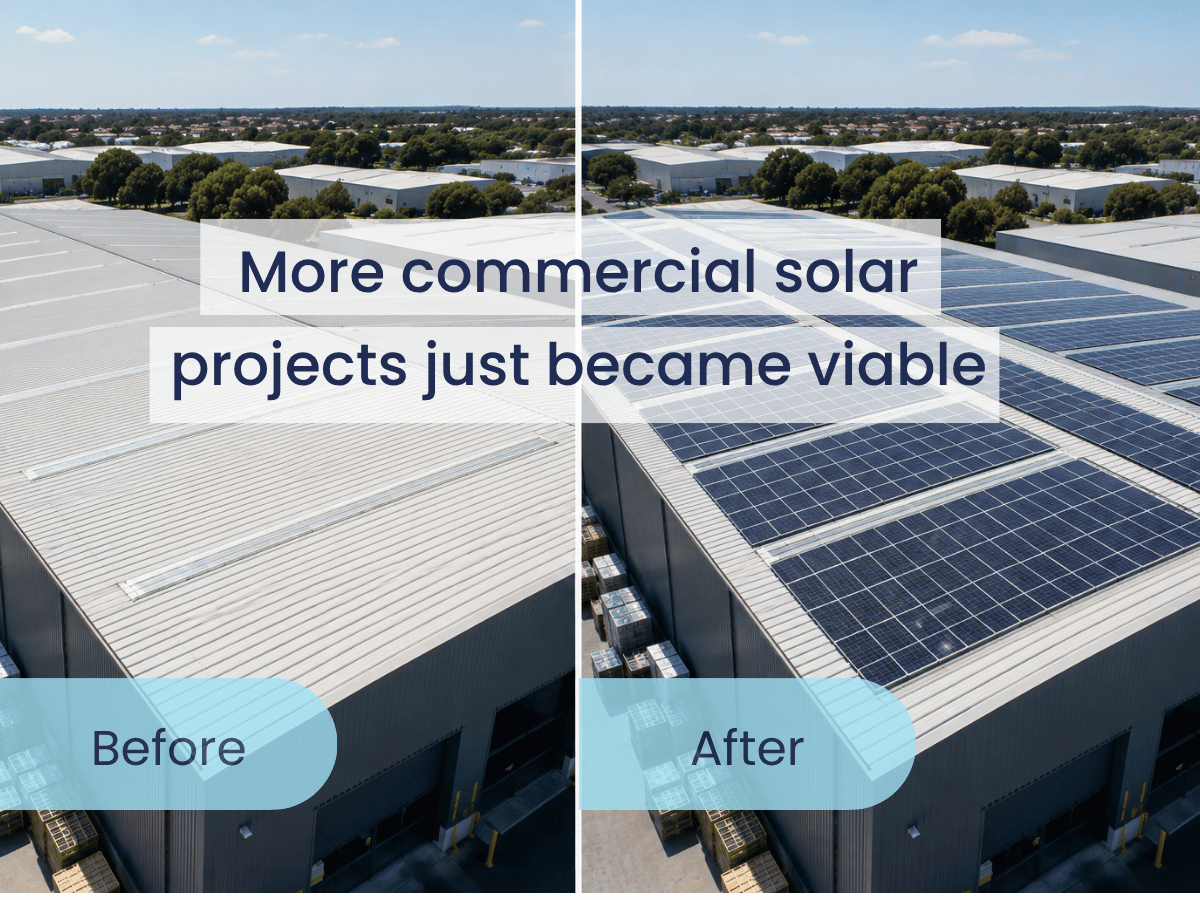
If you work with businesses looking at commercial solar, today’s announcement is worth paying attention to.
The Federal Government has announced plans to expand the Small-scale Renewable Energy Scheme (SRES), increasing the maximum system size eligible for Small-scale Technology Certificates (STCs) from 100kW to 1MW.
If the changes go ahead as announced, many commercial solar projects could become eligible for incentives that reduce the overall project cost by around 20%.
That’s one of the biggest policy announcements for commercial rooftop solar we’ve seen in years. While there are still plenty of details to come, here’s what we know so far.
What’s changing?
Currently, solar systems up to 100kW are eligible for Small-scale Technology Certificates (STCs), which provide an upfront financial incentive and help reduce the cost of installation.
Larger systems above 100kW are currently supported through the Large-scale Renewable Energy Target (LRET) via Large-scale Generation Certificates (LGCs). Under this model, the financial benefit is generated over time rather than reducing the upfront cost of the project.
Under the proposed changes, the Government plans to expand the Small-scale Renewable Energy Scheme (SRES) to include mid-scale solar PV systems.
This means:
-
The current STC eligibility threshold will increase from 100kW to 1MW (1,000kW).
-
New solar installations between 100kW and 1MW will move from the LRET scheme into the SRES, making them eligible for Small-scale Technology Certificates (STCs).
-
STCs for these mid-scale systems will be calculated using the current five-year deeming period, which will continue each year until the SRES ends in 2030, rather than reducing annually.
The expanded scheme is expected to commence from 1 October 2026 and will open up access to STC incentives for a much broader range of commercial, industrial, agricultural and community projects.
Why is this such a big deal?
According to the Government, eligible businesses could reduce the overall cost of their commercial solar project by around 20%.
Examples released with today’s announcement include:
- 250kW system: around $68,000 in STC incentives.
- 500kW system: around $136,000 in STC incentives.
- 850kW system: close to $200,000 in STC incentives.
For many businesses, that’s the difference between a project that gets pushed back and one that gets approved. Better project economics make it easier for customers to see the value in investing now rather than later.
Who could benefit?
The reforms target what Energy Minister Chris Bowen has described as Australia’s “missing middle”: businesses with large rooftops ripe for solar generation that haven’t previously benefited from the simpler STC scheme.
That includes businesses and organisations such as manufacturing facilities, distribution centres, farms, schools, hospitals, shopping centres and community organisations.
If your customers are considering projects between 100kW and 1MW, this announcement could be highly relevant.
Why is the Government doing this?
Australia has been incredibly successful at rolling out rooftop solar on homes, but commercial uptake has lagged behind. Government figures show businesses have installed around 5.6GW of rooftop solar, compared with more than 22GW on Australian homes.
Yet commercial buildings represent one of Australia’s biggest untapped opportunities for rooftop solar. The aim is simple, help more businesses invest in clean energy and make better use of the roof space they already have.
It’s not just about incentives.
The Government also announced plans to improve the process of connecting medium-scale rooftop solar systems to the grid.
For many installers, delays in obtaining network approvals have become almost as frustrating as the project economics themselves.
Reducing those delays could make it quicker and easier for more commercial projects to proceed.
Better project economics. Fewer barriers.
Reducing the overall cost of a project is a big step forward, but it’s only one piece of the puzzle. Many businesses still need to preserve cash flow, protect working capital and manage competing investment priorities.
That’s why we think this announcement makes funding even more valuable. Lower project costs improve the business case.
Smart Ease’s $0 upfront Payment Plans remove the need for customers to fund the remaining investment upfront. Together, they can make commercial solar more accessible than ever.
For installers working in the commercial sector, that means more opportunities to help customers move from “We’d like to” to “Let’s get started.”
Even more good news for NSW businesses.
The Federal announcement isn’t the only positive change on the horizon. The NSW Government is also introducing changes to the Peak Demand Reduction Scheme (PDRS) that are expected to increase incentives for commercial battery projects.
For businesses investing in solar and battery storage, the combination of expanded STCs and new PDRS incentives could significantly improve project economics.
We’ll be taking a closer look at the PDRS changes in an upcoming article, including how they may work alongside the expanded STC scheme and Smart Ease funding.
What’s next?
Today’s announcement is just that, an announcement. The legislation and detailed scheme rules still need to be finalised, and we’ll be watching closely as more information becomes available.
Over the coming weeks we’ll continue to break it all down, including:
- What the changes mean for installers working in the commercial sector.
- How the expanded STC scheme and NSW PDRS incentives could work together.
- How Smart Ease funding can help customers take advantage of these opportunities.
Sources: Putting more roofs to work; Renew Economy; and Clean Energy Council Fact Sheet
At Smart Ease, we’re here to help you make sense of the changes, strengthen your proposals and get more commercial projects moving.
If you’d like to discuss how this announcement could impact your commercial pipeline, get in touch with the team. We’d love to help.